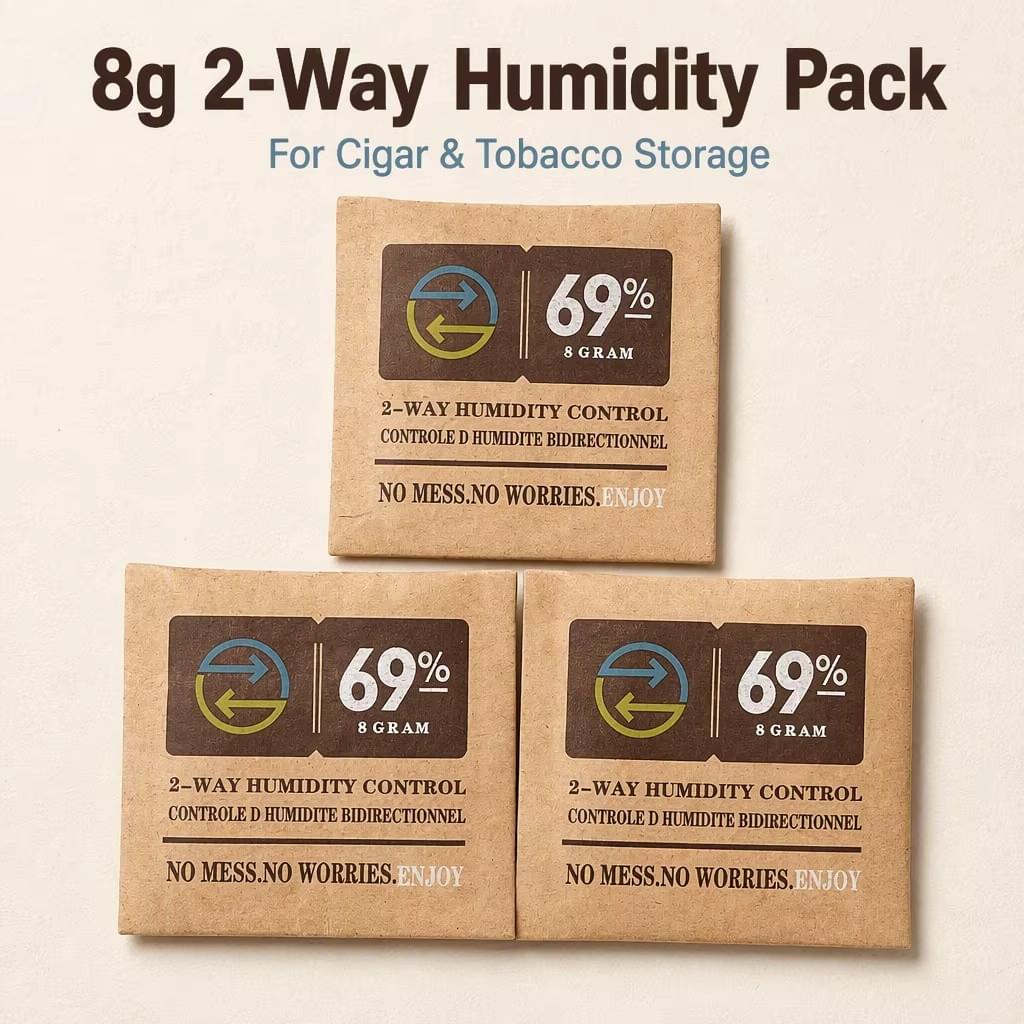
The Saltwater Type and the Plant-Based Type: A Comparison of Two Mainstream
Two-Way Humidity Control Packs
The saltwater type and the plant-based type are the two most well-known and
popular "2-way humidity control packs" (commonly known as humidity packs) on
the market. Their core function is identical: absorbing or releasing moisture
to stabilize the relative humidity (RH) within a sealed container at a specific
level.
These two types are like "Toyota" and "Honda" in the automotive world—equally
capable, but each with its own underlying technology and product nuances.
Below is a detailed comparison of their similarities and differences:
I. Core Similarities: Two-Way Humidity Control
Both types utilize two-way humidity control technology.
- When the environment is too dry: They release moisture to humidify the contents.
- When the environment is too humid: They absorb excess moisture to prevent mold.
This feature makes them ideal for cigar aging, storing herbs, dried goods, and
(in legal regions) cannabis curing.
II. Core Differences Comparison
1. Composition & Working Medium (Fundamental Difference)
The Saltwater Type: Uses a saturated salt solution (e.g., calcium chloride,
potassium citrate, sodium chloride—varies by RH level) mixed with food-grade
thickeners and purified water. The liquid is sealed within a special breathable
membrane.
The Plant-Based Type: Uses a vegetable glycerin-based solution. It is marketed
as a more natural, eco-friendly formula without sodium chloride (table salt).
2. Relative Humidity (RH) Options
Saltwater Type (Extensive Range): Offers a very wide range of RH levels,
including 49%, 58%, 62%, 65%, 69%, 72%, 75%, and even 84% (used for seasoning
new humidors). Notably, 62% and 58% are favorites for cannabis storage, while
65%-72% are the gold standard for cigars.
Plant-Based Type (Streamlined & Practical): Primarily focuses on 55%, 62%, and
72% (with newer additions like 69% and 75%), offering fewer choices. However,
it uniquely offers the 55% option, which is excellent for long-term, static
storage (less risk of mold).
3. Expiration Indicator Method
Saltwater Type (The "Squeeze Test"): Has no chemical color indicator. You
determine whether it is expired by squeezing it. When new, it feels soft and
jelly-like. When it starts to harden, crystallize, or feel like a rigid plastic
sheet, it has lost its moisture and needs replacing.
Plant-Based Type (Built-in Indicator Card): Each pack comes with a humidity
indicator card that changes color when the pack's humidity control capacity is
exhausted. This provides a clear, visual reminder that it is time for a
replacement.
4. Durability & Extreme Environment Performance
Saltwater Type: A well-established category with a long track record and an
excellent reputation. However, its liquid formula can evaporate faster in high
heat or in environments with frequent container opening, potentially shortening
its lifespan.
Plant-Based Type: Many heavy users report that the plant-based type lasts
longer than the saltwater type in hot weather or with frequent container
access. It is also less prone to leaking (using gel/foil technology rather than
pure liquid).
5. Price & Category Background
Saltwater Type: Has been around longer and is widely regarded as a mainstream
reference standard in the cigar world. Individual packs are usually slightly
more expensive than the plant-based type.
Plant-Based Type: A strong challenger that emerged later. Generally offers
slightly better value for money and is more budget-friendly.
6. Opportunities and Challenges
With the increasing global sales of cigars and the increasing legalization of
cannabis in more and more regions, the demand for 2-way humidity control packs
is also growing. Fujian Huawin has successfully developed and produced two
types of humidity control packs with different formulas. The new formula has
been filed for a patent, and the product has passed various safety tests. We
have achieved the same effect as the two mainstream product types mentioned
above, at a lower cost.
Disclaimer: The type-based classification in this article is for technical
illustration only and does not refer to, endorse, or affiliate with any
specific brand or its products.