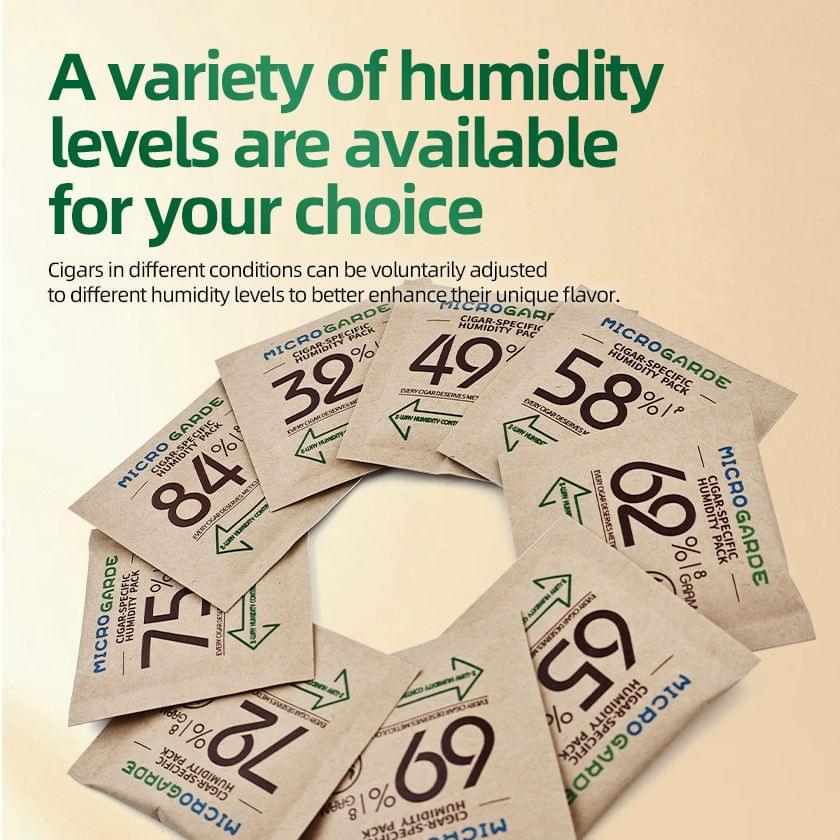
Huawin offers 9 humidity levels, each level is designed for a specific material and storage goal. Choosing the wrong one does more harm than using nothing at all.
32% Humidity
- Primary use: Moisture protection for dry goods and archival material.
- Applications: Loose-leaf tea, coffee, powders, capsules, medicine, health and beauty products; photos, negatives and archival or archaeological material.
- Secondary use: The low point of a two-point hygrometer calibration. Paired with a 75% kit, it brings calibration accuracy from roughly ±2.5% down to about ±1.5%.
- Lifespan: 6–9 months in an airtight package; 2–4 months in a container opened frequently.
49% Humidity
- Primary use: Wooden musical instrument bodies — the only standard level for instruments.
- Applications: Guitar, bass, banjo, mandolin, ukulele, violin, viola, cello, double bass; also clarinet, oboe, bass clarinet and bassoon bodies. Instrument bows use the same level.
- Target range: Maintains a stable 45%–55% RH (the instrument line is described overall as the 40%–60% safe zone).
- Quantity: One pack for clarinet, oboe, ukulele, viola or violin; two for banjo, bass clarinet or bassoon; four for cello, harp, small guitar, standard acoustic/electric guitar or bass, and upright bass.
- Note: A High Absorbency version exists separately for climates above 60% RH year-round — it absorbs roughly three times more moisture while holding the same 40%–60% target. Never use standard and High Absorbency packs together in one case.
58% Humidity
- Primary use: Herbal storage, drier side.
- Applications: Dried herbal material where a drier feel is preferred.
- Characteristic: Drier to the touch, easier to grind, and better suited to shorter holding periods.
- Rule: Never mix 58% and 62% packs in the same container — they work against each other and deplete quickly.
62% Humidity
- Primary use: Herbal storage, preservation side.
- Applications: Herbal material intended for longer-term keeping.
- Characteristic: Retains a softer texture for longer; generally treated as the default for preservation rather than immediate handling.
- Note: This level belongs to the herbal line, not the tobacco line.
65% Humidity
- Primary use: Tobacco storage for a drier profile.
- Applications: For those who prefer a drier taste and an easier burn; also suitable for long-term aging. Well suited to humid climates and to thicker, oilier wrappers that absorb more moisture.
- Food use: Keeps dried fruit plump instead of shrivelled.
- Official positioning: One of four maintenance levels in the tobacco line (65%, 69%, 72%, 75%).
69% Humidity
- Primary use: The all-purpose tobacco level.
- Applications: Wood and acrylic humidors, sealed containers, coolers and humidor bags; also suitable for long-term aging. The most widely chosen level.
- Secondary use: Reviving dried-out tobacco — safe to use directly on dry stock, because the pack acts as a brake and will not push humidity above its stated level. Rehydration typically takes several weeks.
- Food use: Brown sugar (prevents clumping), dried spices and herbs (preserves aroma), popcorn kernels (preserves pop rate).
- For first-time buyers: This is the recommended starting point.
72% Humidity
- Primary use: Two distinct applications — woodwind reeds, and tobacco in leaky or dry conditions.
- Woodwind reeds: Day-to-day storage for single and double reeds — clarinet, saxophone, oboe, bassoon, English horn and contrabassoon. One Size 8 pack covers up to eight reeds and holds 70%–75% RH for roughly 60 days. It keeps reeds from splitting, cracking and warping, helps them hold shape for a tighter seal against the mouthpiece, and inhibits mould.
- Tobacco: For drafty containers and dry environments, or for those who prefer a higher moisture profile.
- Caution: Never use in an instrument case for the instrument body itself — that is what 49% is for.
75% Humidity
- Primary use: Extremely dry conditions only.
- Applications: High altitudes and desert environments.
- Strict restrictions: Never use in airtight containers — sealed boxes, plastic storage containers or humidor bags. Not intended for long-term storage or aging.
- Secondary use: The high point of a two-point hygrometer calibration.
84% Humidity
- Primary use: Seasoning only — never for storage.
- Wood humidor seasoning: Seasons a new or dry wood humidor before use. Place packs in an empty box, close the lid and leave it sealed for 14 days without opening. Discard the packs afterwards — they are not reusable. Then move contents in and switch to a maintenance level of 65%, 69%, 72% or 75%.
- Reeds: Dampens woodwind reeds for same-day practice or performance, so they are ready to play immediately.
- Quantity: One 60 g pack per 25 items of total container capacity. Count capacity, not current contents.
- Why not wipe-down: Wiping the interior with a damp cloth delivers only 2–3 g of moisture to the surface veneer and can warp the wood and invite mustiness; a 100-count box needs roughly 100 g of water, which four 60 g packs supply.
Working Principle
The pack contains natural salts, purified water and a food-grade thickening agent sealed inside a leak-proof membrane. The membrane passes only pure water vapour. When the surrounding air is too dry, the pack releases vapour; when it is too moist, the pack absorbs it. This two-way action holds the container at a precise relative humidity, accurate to roughly ±2% when the recommended number of packs is used. It is food-safe and safe to contact stored items directly. Nothing needs to be activated or added.
Quantity and Replacement
- Tobacco: One 60 g pack per 25 items of total capacity. One 8 g pack per 5 items. The largest format, 320 g, suits medium and large humidors, coolers and wine coolers.
- Adding more: Using more than the minimum does not over-humidify — it simply reaches the target faster and makes the packs last longer. The salt solution cannot release moisture beyond its stated percentage.
- When to replace: Perform the touch test. The pack is still working if only the corners have hardened or if soft spots remain among hard areas. Replace once the entire pack feels rock solid throughout. Order replacements before it fully hardens, so protection never lapses.
- Typical lifespan: About 2–5 months in a dry instrument case; roughly 2–4 months in a wood humidor; 6–9 months in an airtight container. Consumption runs faster in dry climates and slower in humid ones. Unopened packs stay fresh for up to two years in their sealed bag.
Important Prohibitions
- Do not mix levels. Never place packs of different RH percentages in the same container — they fight each other and deplete rapidly.
- Do not mix products. Never use these packs alongside sponges, gels, beads or other humidification devices in the same container; they counteract each other and reduce efficiency.
- Do not open the pack. Remove only the clear outer overwrap. Never cut or tear the pack itself.
- Keep it closed. Always keep the container lid shut, whether or not the contents are inside.
Application Fields
- Instrument protection — guitars, violins, cellos and other wooden instruments, plus woodwind reeds and bows.
- Food storage — tea, coffee, dried fruit, brown sugar, spices and popcorn kernels.
- Herbal storage — humidity control for dried herbal material.
- Archives and packaging — photos, negatives, powders, capsules, medicine and other moisture-sensitive goods.
- Hygrometer calibration — dedicated kits at 32% and 75% for calibrating digital or analogue hygrometers and humidity sensors.
Beginner Recommendations
- Start at 69% — the official recommendation for first-time buyers and for most environments.
- Use a well-sealed container — a sealed box holds humidity far better than a wood case or a gig bag.
- Calibrate first — calibrate a new hygrometer before putting it in the container, even if it claims to be pre-calibrated, then re-calibrate every six months.
- Check regularly — verify the reading periodically and use the touch test to gauge pack condition.
- Stable environment — keep the container at room temperature, away from direct sunlight and heat sources.